Wednesday, February 16, 2022

More Prose Poems

The doorbell rang
The courier handed
Me a packet, a book
And I thought that
It was the book in which
I have a story and a poem
And I reach the kitchen
And cut it open
To find a book
That the husband had
Ordered for himself.
My monkey mind
Had jumped so far ahead
Of actual reality
I was, in my head,
Posting a photograph
Of myself with the book.
Sorry folks, you'll
Have to wait a bit longer!

3rd February, 2022

I cannot, in good conscience,
Listen to Rolf Harris any more,
Or to the Gundecha brothers,
(Although their Jhini Jhini was sublime).
I also cannot stop the spouse
From buying a book by a certified creep
Who, I am so glad to say,
Lost the defamation case
He had slapped on the woman
Who accused him of molestation.
The spouse was reading the book
In the car, and fell asleep, snoring.
The book lay face down on the seat,
Infringing upon my space,
While I shrank away from it,
Distressed by the presence in my life
Of that ugly, beastly, name.

We didn't meet Vishakha this evening
(Her husband was one of our teatime guests)
But used her name to educate the spouse
on the guidelines of the same name.
The second set of visitors
Included my staunchly feminist niece
So the spouse was further educated
On the 'Me too' movement as well as
The creepiness of yesterday's author,
And other famous folks
Now infamous for their lechery.
Waiting for him to bury that book now!

4th February, 2022

Pre-dawn this morning
I hear the mellifluous notes
Of a magpie robin
Piercing the silence, briefly.
Then silence again.
Did it go back to sleep,
To snooze until dawn?

9th February, 2022

Treasure Hunt
For the past few days
The spouse has been
Missing a book which
Was on his bedside table
An unspecified while ago.
It was a book of Hindi poetry
A paperback, with a green cover.
Poet unknown, name of the book
Also unknown.
I say 'missing a book' deliberately
Because looking for a book
Seems to be too tough a task
For one whose mind is almost
Always preoccupied
I was willing to look, no easy task
In a house as privileged as ours
With many books in many shelves
Often in double rows.
I needed more clues.
The spouse had a photograph
On his phone, of a page
From this book.
Perhaps the font would help.
(How, I wondered, could it?)
He had shared this photograph
Of a poem with a friend,
Who wanted to know
the name of the poet,
Hence the need for the book.
And then, he saw that the photograph
Showed a strip of the adjoining page,
The edges of English words.
Eureka! This is one of
Javed Akhtar's books
Transcribed and translated
Into Hindi and English,
That much I remembered.
I thought it was Tarkash.
Into his study, into the cupboard
Where the overflow of his books
Is stashed, and I spot
The mustard spine, no green anywhere,
Of a book called
In Other Words, by Javed Akhtar.
(Hindi on the left hand page,
English on the right).
I hand it to the spouse.
Happy Valentine's day!

14th February, 2022

Wednesday, February 2, 2022

Random Recent Writings

1st February, 2022

Today I morphed into a gyaani
Publicly offering wisdom
to the young man in the bank
Young man with a maroon knitted cap
Who just had to get a cheque 'received'.
He tried jumping the queue
But the counter clerk told him
To join the line like everyone else.
The two customers before me
Had time-consuming dealings
And this young man, just behind me
Was grumbling away,
about how useless and
terrible this bank was.
With all the kindness (and patience)
That I could summon up,
Overcoming my natural diffidence
I spoke to him, telling him gently
That today is the first of the month
A busy day for bankers,
And if you are in a place
Where you have to wait for a while
Curb your irritation, and use it well
Think good thoughts, remember God,
If you happen to believe,
And do not let your mind
Be agitated and restless.
He listened, perhaps stunned
By this strange, masked woman,
And said that he believed
In his Thakurji.
I then spent half a minute
At the counter,
Getting two cheques 'received'
And left, exchanging with him
A warm and friendly smile.
I sometimes surprise myself!

21st January, 2022

When there's not enough
leftover rice to put away
or to give away,
and which you don't want
to throw away
the pigeons come to mind
as avian waste disposal
Put it on the outer edge
of the balcony railing
Whitey comes along
with a lean and hungry look
This winter has been a harsh one
others follow,
and you find yourself
reaching for a stale roti too,
wondering if you are being a fool
inviting the pestiferous pigeons
into your territory.
The squirrel comes along too,
foraging, charming,
as desi squirrels are.
A quick look in the fridge
finds a forgotten lump of paneer,
stale and smelly.
You break it into pieces, and leave it out
and wonder if it will be eaten
The squirrel sits there quietly
whiskers aquiver, while 'suspigeons' wonder
if this white stuff is food or not.
You come back after a while, and its all gone,
as are the squirrel and the pigeons.
16th January, 2022

The spouse sometimes has
Two hardboiled eggs
For breakfast, or dinner.
I knock them together
To shell them, and have observed that
The egg in my left hand always cracks,
Is the 'hittee', to coin a term
While the one in the right hand
Remains whole, the hitter,
Till I crack it on the worktop.
Is this a metaphor for life?
Hittee and hitter are both
Sliced,salted, peppered
Consumed.

12th January, 2022

In the cold of winter
In the midst of the gloom
The limes are ripening
As new flowers bloom
Many leaves are browning
There is much decay
But there's the promise that spring
Isn't too far away


3rd January, 2022

The sickness and rot
Spreading like a cancer
Through minds that know
No grace, no love
A cancer fostered by
Impunity pumped within
This sick system
Dehumanizing all
But the few they consider
Worthy of survival
In mera Bharat mahaan
Excluding many
Targeting minorities
The underprivileged
Underdogs, who ache
To survive with respect
Just a modicum of it,
As human beings
As equal citizens
In a country that belongs
To us all.
My heart aches
At the rot, seemingly
Untreatable.
Please prove me wrong.

Sunday, January 2, 2022

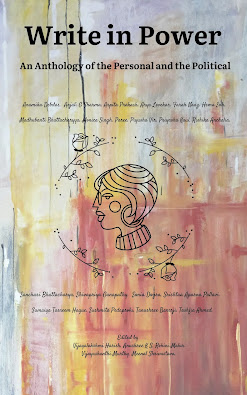
Book Review: Write in Power: An Anthology of the Personal and the Political

 I bought Write in Power: An Anthology of the Personal and the Political in October 2021, after watching the beautiful webinar organised for its launch. It was a book I simply had to read, also because I had recently read Vijaylakhmi Harish's brilliant book, Strangely Familiar Tales.

When I browsed through the index, once I had the book, I was pleased to see some familiar names, of women I 'knew' on Facebook, Srishtaa Aparna Pallavi, Hema Gopinathan Sah, Anjali G. Sharma, (whom I have had the pleasure of meeting). Their poems are powerful and hard-hitting.  I quote from Hema's poem,  A Prayer For/To Everywoman:

There was a body I was born with, this body, though, I have earned.                                                         

I am not pretty. I am beautiful.

In another powerful poem, she writes

Do not insult these hands that wear bangles.                                                                                              

Upon them you are held.

It is hard to do justice to this book without writing about each and every chapter. Let me mention a few themes off the top of my head: a voluntarily child-free woman ponders the impending loss of her uterus, in a chapter that is both moving and hilarious. A visually impaired woman recalls the agony that was her schooling. A neighbour attends a memorial service at the home of an elderly mashima who seems deeply unloved and unmourned by her family. An accidentally pregnant woman is brow-beaten by several gynaecologists who disagree with her request for an abortion. A widowed mother goes to buy gold jewellery for her daughter's wedding, in a chapter that speaks volumes about the treatment and status of widows even today. A woman whose husband's criminal activities endanger her life and well being. A Dalit woman's agony at the death of her auto-rickshaw driver father's death. A member of the minority community decides to emigrate, sacrificing all his childhood dreams and aspirations. A community where young girls fake possession as Devis. A girl is fat-shamed by her so-called well-wishers. The difficulties of coming out as queer, not just to family and friends. The beautiful chapter called Meditative Monsoon Recipes for Healing Chronically Ill Queers. There is much much more, as well as powerful poetry, wonderful art.

It is a book that shakes you out of ignorance and complacence. It is an education in empathy, brilliantly and beautifully written, curated, and edited. I conclude with an excerpt from the editorial team:

The Hidden Pen Collective seeks to amplify writings from South Asia, from the margins imposed by caste, class, gender, race, religion, and sexuality. For aeons, our stories have been set aside, our voices have been silenced, and we find in the 21st century that we are still struggling to be heard.   In this compelling anthology of fictional and non-fictional prose, poems, and art, we present the writings of twenty-four writers and artists from an inclusive spectrum of human experience. These perspectives speak to the intersections of the personal and the political creating a space for discussion and change. We find our power in our traditions, or by breaking those traditions. We look outwards for love and acceptance, or to our own selves because we are all we have. Our stories - rebellious, accommodating, loving, suffering, defeated and in victory - declare our essential power.

Saturday, January 1, 2022

Squirrel Tales/Tails?


I have a very strange relationship with American supermarket baked goods. They are too big or too sweet, or just too unfamiliar. My last visit to Tennessee feels like a lifetime ago. On that last visit I was attacked by severe cake cravings. For just a simple fruit cake, not a creamy, iced kind of cake. My second grandchild had arrived, and neither the mother nor the grandmother of the newborn baby were in any mood to bake.

I walked to the local supermarket, a beautifully located chain store. I would ramble around the suburban streets, admiring the beautiful gardens on my way to it, but would take the shortest route home, inevitably lugging more than I had planned to. After much searching in the shelves and display cases, I found a box of blueberry muffins, tiny ones, perhaps an inch and a half across. They were triumphantly borne home, along with the regular fresh produce.   Once home, I took a bite, and was most upset with the cloying sweetness. I asked my son to take a bite, and he was equally horrified. (Also that his diabetic mother had been foolish enough to buy cake). The older grandchild was rarely given sweet stuff. Could we give them to her nursery school teachers? No, because the box was now open. My son told me to just throw them in the trashcan, but my desi heart rebelled.

I wandered into the back yard. There was a tree with forked branches, where I would often spy large American squirrels. Hmm. The squirrels might make good guinea pigs for the muffins. No harm in trying. And so, out of the remaining eleven muffins/cupcakes (can’t really tell the difference) I kept two in the fork of the tree, whose name I never knew. (My son didn’t know it then, either). I kept a watch from the kitchen door, and to my great delight, the muffins were devoured in no time. For the next few days it was party time for the backyard squirrels. They came, they saw, they gobbled. Every day until the wretched muffins got over. They must have wondered where the muffin dispensing person had disappeared to.

I am sorry to say that I do not really love American squirrels. They lack the petite charm of our little desi ones. Their white stripes are supposedly the result of Lord Rama stroking a squirrel’s back, when it tried to help build the bridge to Lanka by carrying pebbles in its tiny mouth. I love squirrels in the great outdoors, but am never glad to see one on our seventh floor balcony, which I do occasionally. My cousin’s air-conditioner’s outdoor wires were chewed up by squirrels. His wife’s blouse was stolen off the clothes line and stuffed inside the airconditoner to line their nest. Not good neighbours at all.

Nonetheless, they are beautiful creatures, with their bright, shiny eyes and bushy tails. Whenever the Covid gods permit me to meet my grandchildren, I might celebrate by buying a box of blueberry muffins just for the backyard squirrels.

Prompted to write, Mathangi's challenge for December 2021

Mathangi Krish was kind enough to set us another writing challenge, this time for a mere seven days this December. When I accepted the challenge a while ago, I didn't know that I would be travelling/attending a wedding during the last three days, and would be writing on my phone. So I am justifiably proud of myself for completing this. Also, no word count for the last three posts. 

But anyway. I write. Does that make me a writer? I hope it does!

 Writing prompt no.1:

Go take a walk. What did you see, hear, touch, smell, feel?
A Voluntary Involuntary Walk
I love to walk, but my walks are usually limited to the tiny, microcosmic world of my housing complex, with its familiar walking paths, trees, birds, and cats. Today, though, was an adventure. I had to go to Jamia Milia Islamia, to meet a friend, and didn’t have the time for my morning constitutional. I booked a cab, which took me more than half way there, before it developed a flat tyre. I was near Kalindi Kunj, with Shaheen Bagh to my left, and the Yamuna, fiercely protected by high fencing and trees which rendered it invisible, to my right. I decided to walk for as long as I was able to, before looking for an auto or another cab. December in Delhi is walking weather, all day long. Truly, no sweat!
There was a stink, though. The rubbish dump was off the road, behind a fence, but there was a stench. There were a large number of sinister looking pariah kites (scary birds that terrorized innumerable school children by swooping down and grabbing their food in the playground), and egrets perched on the branches of the acacia and neem trees edging the road. I hurried past, thankful that it wasn’t summer, and crossed the market, most of the shops elevated 3-4 feet above the road, selling furniture, clothing, curtains. A large building was called the Market Basket Complex, but it was closed, and I didn’t really have time to explore! I walked past Ashraf Masjid, and Noor Masjid, and the Jamia Nagar Post Office. And then, there was this long, blank wall to my left. What was absolutely fascinating about this stretch of the road and the wall was the number of horses standing there. I kept a safe distance from potentially dangerous hooves, and walked. It was, apparently, breakfast time for the horses. The first feeding trough, an old fibreglass bath tub, seemed like an anomaly. The next couple of horses were feeding from tall metal drums, occasionally neighing in satisfaction. There were no carts nearby, though, and the horses were tethered but otherwise unattended. I wondered why they were there. I walked on for about a kilometer, noticing several decrepit bathtubs being used as troughs, and many more horses. I wondered where all this detritus came from, testimony to the fact that in India nothing is ever actually wasted. Horses and bathtubs, a surreal sight indeed.
The road turned into a busy market full of small eateries. There was the heady smell of samosas and jalebis frying. A shop that made rotis in a tandoor. Fruit shops and juice shops, shops that could make number plates, including the new high security ones, apparently. A loud thud: a cycle-pulled handcart laden with vegetables had overturned. Several young men rushed to help the hapless handcart wala. I realized that I had another five odd kilometers to traverse, and was getting late. I hailed a passing auto, mulling over the richness of life outside my little sanctuary.

Writing prompt no.2:
Pluck out any one element from yesterday's piece and weave a speculative tale (fiction or non-fiction).
A Road Less Travelled?
Thanks to Covid and the associated lockdown, the long standing anti CAA protest site at Shaheen Bagh had to wind down. Whenever I pass that road now, I cannot help but remember the vibrant protest site, the camaraderie, the willingness of the shopkeepers to keep their shops closed so that the protests could continue, the extreme traffic jams on the other major road connecting us Noida-waasis to Delhi, the innumerable performers who came there in solidarity, the food that people would bring and share, the grandmothers and homemakers who willingly disrupted their lives, the entire movement of a people asking for justice.
Let us assume, for a moment, that Covid had not arrived, wreaking havoc in its wake. The protest site at Shaheen Bagh is still as busy and vibrant as ever. Civil society is even more invested in the protests, and the movement grows stronger day by day. My friend Chinna Dua has not succumbed to Covid. In my mind’s eye I see her singing Faiz’s immortal words, Hum Dekhenge, as she had earlier sung at Jantar Mantar, when we were protesting Akhlaq’s death, and Junaid’s death, when we had gathered to say, loud and clear, that every life is precious, and we are all equal citizens of India. Since this is merely speculative, I can happily say that the government finally acceded to the demands of the protestors, and scrapped the CAA. What a happy fantasy!
And if I have the liberty to assume stuff, let me go further back in time and assume that the police did not attack Jamia Milia Islamia students two years ago, entering, with impunity, the hallowed portals of a central university, and hence no students are still suffering from the physical and emotional trauma of that attack, which happened exactly two years ago.
If I could change history, I would erase the trauma of Partition. Shaheen Bagh and the surrounding area would not be thought of as Muslim ghettos, but would have a rich and vibrant mix of people from all communities. (You may say I’m a dreamer, but I’m not the only one). I speculate here with great sorrow, knowing that realities are harsh, that my privilege allows me to speak, that toxic hatred is manifest today more than ever, and there is little that I can do to stop it. And yet I must reiterate, in whichever forum I can, that all human beings have an equal right to live long and prosper.
Perhaps the horses in the Okhla/Jamia areas are harbingers of peace and harmony, and the old bathtubs are feeding them with Love, which they will magically share with suffering humanity. Perhaps the polluted Yamuna that flows past, becomes pristine again. Let the open rubbish dump vanish, and the kites and egrets find better things to feast upon. Perhaps the vegetable cart did tumble over, even in my speculative world, but it’s nothing that I need to change because there were helping hands around...

Writing Prompt No.3: Gauge the dominant emotion, affect, rasa, of your previous piece and write a non-fiction essay on its contours.
Hope Central
Is clueless optimism a rasa? Looking at my last speculative post, it certainly seems to be. Does being optimistic help anyone but yourself? And being clueless, floating around in your happy little bubble, because you have decided that, whatever difference you aim to make in the world, you cannot make it without a degree of self–preservation. Essentially, putting on your own oxygen mask first, before trying to help anyone else.
In today’s dark and dreary world, I try to preserve my sanity and my optimism by avoiding the news insofar as possible. Watching a very very important personage taking a dip in the Ganga neither edifies nor instructs, and I’d honestly rather not even imagine it. And yet, my mental cordon sanitaire is not impermeable, the world trickles in, and is dealt with, with as much or little attention as I can muster at that point.
The clueless optimist actively seeks joy. The magic in the commonplace. In the curve of a baby’s cheek. In a geographically distant grandchild’s plaintive: “I don’t want to talk”. In the rumbling morning mutterings of our resident kabootar clan, late risers, the lazy lot of them. In capturing reluctant cats with my phone camera: they seriously seem to wonder at my sanity. In walking, the sheer blessing of being mobile. When you have seen your family elders bedridden and immobile, you cannot really take mobility for granted. Actually, the entire ‘normal’ functioning of both body and mind is a source of both wonder and gratitude.
There is joy to be found everywhere, but it sometimes disappears without a trace. Violence in the world is an instant depleter. Any one of my children being unwell or unhappy. The full janjaal of moh and maya, huge sources of both joy and sorrow. An acceptance of the ultimate reality of death, though the sudden ones, or the apparently untimely ones take much getting used to. Physical pain, illness, especially long drawn out illnesses. The harsh reality of the pandemic, with no end date in sight. The unknown.
The clueless optimist muddles through, trying to learn about the world and life without getting bogged down in it. Coping with technology, and being reasonable au courant and somewhat competent with it, makes life easier. Gratitude for what is seems to be a central attribute.
Doing what you can do. Perhaps very little, but perhaps your little encouraging word makes all the difference to someone who is struggling. Giving what you can give, without expectation.
In the immortal words of Max Ehrman, in his prose poem Desiderata, lies my creed.:
And whether or not it is clear to you, no doubt the universe is unfolding as it should. Therefore be at peace with God, whatever you conceive Him to be. And whatever your labors and aspirations, in the noisy confusion of life, keep peace in your soul. With all its sham, drudgery and broken dreams, it is still a beautiful world. Be cheerful. Strive to be happy.

Writing Prompt No. 4
(a) Employ 3 characters, one embodying the emotion/ affect you picked for your previous piece, one embodying its opposite, and the third illustrating any other emotion/ affect of choice.
(b) Stage an event/ occasion with dialogues.
(c) Fiction
Thesis, antithesis
Thanks to the pandemic, Meeta hasn’t been able to visit her parents for over two years. After the initial euphoria of her arrival, Meeta finds her father very gloomy and withdrawn.
Meeta: Ma, what’s the matter with Papa? He seems much quieter than usual.
Ma: Kya bataoon, he doesn’t seem to like anything these days. If I’m singing while I’m cooking, he’ll ask me what is there to be so happy about!
Meeta: And what do you tell him, Ma? Why are you so happy?
Ma: Meetu, you know me. Thankful for each day that the good Lord has granted me. You and Ravi are both well and well settled. Haan, I miss my children, but I know you have your own lives to lead. And I can see you on video calls, it’s almost as good as being with you, apart from missing the hugs, and feeding you your favourite dishes. When I was young phones were so few and far between, and calls were so expensive. Baaqi, I have my home and my garden and my books and my music. What more do I need?
Meeta: But Papa seemed okay whenever we spoke, he seemed fine even on video chats.
Ma: He was happy when he was talking to you. But he’d become very quiet again once the call was over.
Meeta: Well, I’m here now.
Papa enters, sits down, glumly.
Meeta: Good morning, Papa.
Papa grunts.
Meeta: Are you worried about something, Papa?
Papa: What has to happen will happen. My worrying won’t change anything.
Meeta: That is true, but a worry shared is a worry halved, no?
Papa: This pandemic has ruined the balance of the world. I am so far from my children. If I fall ill, you may not even be able to see me one last time.
Meeta: Things are much better now, you can always come and stay with me. And Ravi has been asking you to move to his place ever since you retired.
Ma: We’ve spent exactly one week at Ravi’s place, before the pandemic, and then too your Papa only wanted to come back here. He was like Ravi when he was little, he’d tag along with me to Buaji’s house, and then spend the entire time there whining Ghar chalo, ghar chalo.
Papa: You can mock me, Gayatri, all you like. I want to be in my own house.
Ma: As if you are all that happy here. No one would think that you are happy to see your only daughter, looking at your long face. Hmphhh.
(Ma stomps off to the kitchen. Meeta takes both her father’s hands in hers.)
Meeta: Kya baat hai, Papa? You know you can tell me anything.
Papa: Kya bataoon, beta. Nothing feels good. All my medical tests are fine, but nothing feels good. And you, my darling child, have come after so long only to leave me again in two short weeks.
Meeta hugs her father, and goes to call her best friend, a psychiatrist. She is sure that a mild anxiolytic will help.

Writing Prompt. No.5
Plant an object in your scene/ event/ occasion from your last piece and write its story. Non-fiction out of a fictional piece.
Rosie appears to be in intensive need of both a physiotherapist and a hairdresser. She also needs a new wardrobe. Her old blue and white striped sailor collar dress is ragged. Her underwear has lost all semblance of elastic, and slips off the minute she is held vertically. Her head tilts to the right, and one arm seems to be in imminent danger of detaching itself from her torso, with its gently rounded belly. Her blonde curls have matted into an amorphous dull brown mass, almost like the 'jatas' sported by the sadhu babas that Meeta found so frightening as a child. Her shoes, tiny white plastic ones which buttoned up with a sharp click, are now a dull, uneven grey. Rosie is a mess. But Rosie is precious. Rosie is more than sixty years old now. Rosie belonged to Meeta's mother, Gayatri, and her younger sister Arti Masi. Their father, Nanaji, went to England on business, and brought back what was known then as a walkie-talkie doll. If you tilted her, face down, a strange sound emerged from her innards, something between 'Awaawee' and 'Mummy'. There was some kind of speaking device embedded within her, with tiny round holes. Rosie had pretty pink cheeks, a rosebud mouth, china blue eyes, with eyelids that closed and opened when she was tilted. For Gayatri and Arti she was the most beautiful doll in the world. Both sisters were gentle with her, and so was Meeta, when she had the privilege to 'own' her. Rosie's troubles started after Meeta grew up and went off to college, and then abroad, for doctoral studies. On one stray visit, Ravi's then three year old son got hold of Rosie, and manhandled her. Gayatri managed to rescue her before her grandson could wreak further damage upon her.
Meeta was rummaging through the store room, looking for the carton of her childhood story books to donate to a library, when she spotted a disconsolate Rosie sheathed in a plastic bag. She cleans up Rosie with moist cotton wool, and goes and buys a new born sized frock with matching underwear. She dresses Rosie in these new clothes. Rosie glares into the distance.

For Writing Prompt No.6:
For your penultimate exercise, gather everything you have written so far and write a story (fiction) with a plot -- a beginning, a twist, and a denouement, with a key phrase from each of your essays so far. Mark each phrase in inverted commas.

Shiny taps
Staying in a hotel was immensely liberating for Rani. Not only did she not have to cook or clean or make packed lunches for husband (and, earlier, children), she could let the bathroom taps get splashed without bothering to wipe them down. No one else bothered to wipe them, anyway, but she hated the destructive effects of hard water, "wreaking havoc in its wake". She was, in her head, the woman with shiny clean taps in a shiny clean home. She was tired of being that woman.
The children were grown up, one in a far away college, one working abroad. Her husband had a week long conference in another city, and so, Rani was ready to explore "the richness of life outside her little sanctuary."
Rani had earned a goodly sum from her home tuition classes, from which she was taking a short break. Ravi never knew what she earned, and neither was he curious. He had, truth to tell, gotten more than a little bored with home and Rani. He used to call her his doll, 'the most beautiful doll in the world.' But he had found a new doll now. He was not, actually, working, that particular week. Nor was he travelling. He and his secretary were holed up in this nature resort a couple of hours away from Delhi. He and Rani spoke, morning and evening, dutifully.
Rani had splurged on her secret holiday. She swam in the hotel pool. She had massages in the luxury of the hotel spa. She enjoyed her solitary cocktails, reading, sunhatted, at the poolside. She felt deliciously guilty, and even more deliciously, free. She didn't quite know what had "ruined the balance of the world " that she had shared with her family, but she knew that something had. This break was helping her clear her thoughts, decide what she actually wanted to do with her life.
And then, she gets an agitated call from Ravi's secretary. Ravi has tripped and fractured his ankle. He is in hospital. She needs the insurance papers. Rani is/acts surprised. Wasn't he supposed to be in Mumbai this week? Why is he in hospital in Delhi?
She checks out of her hotel, walking carefully, thankful for "the sheer blessing of being mobile". Ravi will have some explaining to do.

Writing Prompt No.7: What will you write in 2022? Go on, set your intentions in 500 words.

Why do I actually want to write? What do I have to say that hasn't been said before, and better? Does the world benefit from anything that I have to say? Only in answering these questions will I find my writing intentions for the coming year.
I want to write to share the bits and bobs of magic I find in the everyday. Unexpected love and human concern, in a world which often seems harsh and meaningless to many. I remain aware of the privilege that allows me optimism, yet I see joyfulness among those far less privileged.
The motherly security guard who frisked me at Raipur airport today was very concerned about the two young girls who had preceded me. One had cuts all along her forearms, had no father, and her mother worked in Delhi. The girls were going to Bangalore, were tattooed and had piercings, were skimpily clad under their jackets, and she was genuinely concerned about their welfare. We were joined, for just a moment, in our helpless concern for the young.
I find joy in writing and I find joy in being read. Which means, that at the fabulous age of sixty six, I need to carve out the time to do so. Dear friends have been encouraging, knowing that I am a permanent member of the dhakka-start school of writing. Kiran Manral has insisted on a 500 word a day output, which she has promised to monitor. I see lazy me, already bargaining for time off on weekends and holidays, even before I have begun.
My joy in reading needs to meld with my fondness for writing: I need to share my thoughts about the books I have loved and haven't written about. My greed for reading new books needs to be controlled, until I have listed them with a teeny tiny impressionistic review, at the very least.
Shall I be very ambitious and translate my love of theatre into a play??? A thought to mull over.
I have to convince myself that my writing matters, that I have something to say, and that it matters to someone besides myself.
In that hope, I am writing these somewhat wishy-washy intentions whilst flying from Raipur to Delhi, and will post them as soon as we land. I was motivated enough to complete this challenge while attending a family wedding celebration, for which I am mentally patting myself on the back. Daily riyaaz is a must, which I must make a part of my routine.
Intentions are solid, boss.

Tuesday, December 14, 2021

The Garden Of Heaven by Madhulika Liddle: my three reviews!


An Exquisite Historical Tapestry : My Amazon review

Madhulika Liddle has surpassed herself with this exquisitely crafted novel, set in the Delhi of the twelfth to the fourteenth centuries, the period between the conquests by Muhammed of Ghur, and Taimur. Epic in its sweep, peopled with beautifully etched characters, representatives of two families whose lives intertwine across the generations. Actual historical figures add to the authenticity of the stories. Many of our present day concerns are reflected in the narration. The interaction between members of different communities,i.e. the conquerors and the conquered, have interesting social ramifications. Razia Sultan, Yogi Maiyya, and Jayshree, among others, are strong women whose actions affect many others. The relationships between the sexes are sensitively depicted. The book is structured very cleverly, interweaving its several discrete threads into a beautiful whole. A book to be read and re-read several times. The city of Delhi is depicted in a fascinating manner, and is, indeed, a central character in the book!

The Garden of Heaven (The Delhi Quartet #1) : My Goodreads review

An exquisite look at a turbulent period of Delhi's history, through the eyes of members of two families. The family of Sridhar Sahu migrates to Delhi in peacetime, in order for Sahu to further his fortunes. Young Madhav loses his entire family and village as Muhammed of Ghur's marauding army, led by Qutbuddin Aibak, wreaks havoc upon the civilian population as well as upon the army of Prithviraj Chauhan. The old stone carver, Balram, takes the terrified child under his wing and they start a new life in Delhi, settling down in Yoginipur. Yogi Maiyya is a fascinating character, a strong, independent widow who fends for herself, and has a soft corner for the most vulnerable. Liddle's characters are beautifully etched, as are the scenes she depicts. The story continues across generations, introducing much social commentary as the local populace learns to co-exist with the invaders. This fear of the 'other' is beautifully depicted in Girdhar's story. Razia Sultan appears in an intimate, personalized, cameo. Her friendship with Jayshree, Sridhar's granddaughter, has ramifications for the subsequent generations. i was delighted to see two of my favourite Delhi personages, Hazrat Nizamuddin Auliya and his devoted follower, Amir Khusro, as part of the narrative. The book is exquisitely crafted, with each story a richly woven panel, which forms an integral part of a larger tapestry. A book to be read and savoured again and again.

                                                                 xxx--xxx--xxx

My very personal, subjective and emotional response to this book, which I read and re-read several times, and will read yet again. I am trying to analyse why I like it so very much, and perhaps that is more to do with me than with the book, but here goes:

The stench of war and the destruction in its wake frames the book, in a fraught, moving narration. War becomes the leitmotif  of the book, the prime mover that changes lives in an instant, no less than a devastating natural calamity. Families are destroyed, children orphaned, settlements destroyed. A peacetime migration for ostensibly economic prowess precedes the warfare, and a family settles down in the outskirts of Delhi. The conquering army 'settles' into its new abode, feared as the other, and yet needed as the provider for the conquered. The tensions between the conquerors and the conquered are beautifully depicted, sadly reflected till the present day. Despite the horrors of war, and the eternal apprehension of the 'other',  there is also immense kindness between many of the characters. It is a book written with compassion, and despite the devastation it depicts, there is also much growth, of the city, of the characters, across the generations. 

(Growing up in Delhi in  the sixties and early seventies, wars, both actual and potential, were a grim reality, leaving an entire generation with memories of blacked out windows and air raid sirens and safety trenches. Fortunately I was never directly affected by war, but the fear of it remains deep within me, along with my fear of natural calamities).

The book speaks to me of a familiar milieu, of the land of my ancestors, who were also, historically, long ago migrants. In reading this book, I recall the comfort offered by the first grown up story teller of my life, my beloved Phupha. (My first ever story teller was my sister.) On our return to Delhi after six years in England, I was all of eight, my sister ten. We could understand, and also speak Hindi, but most inhibitedly. English was our comfort language, in a place that was so utterly different from anything that we we were familiar with. Those few months at my aunt and uncle's home, until my father was allotted his own government accommodation, were a strange orientation to our new life, back in the early sixties. Phupha would, every single evening, tell us stories, from the Ramayan, the Mahabharat, and Russian folk tales, all in English. He would also, when able to, take us to the playground at Birla Mandir. He was the most grandfatherly member of my family, and I miss him still. Even when I was a grown up myself, (or appeared to be one), his wisdom and kindliness were always a source of great sustenance and comfort. I am dipping into The Garden of Heaven again and again, finding so much similar beauty and comfort in its pages.

When a book has the power to move you like this, and to give you more and more insights on each reading, it is very very special indeed. Your beautiful book, Madhulika, speaks to my soul. 


Wednesday, December 1, 2021

Mumu Shelley: a brilliant new film


Batul Mukhtiar's new film is a delight. It starts with a very very familiar desperation: the need for a loo! Aiman Mukhtiar plays the role of Shelley, the girlfriend of the omni-absent Mishti. Mishti is supposed to be meeting her at her (Mishti's) cool Mumu Didi's home, so that Mumu can help Mishti come out of the closet to her family.

Mumu, (played by Pubali Sanyal), however, battles demons of her own. Her first (sun-hatted indoors, in the evening) appearance has her politely pleading with her husband to attend the dinner party she is hosting that evening. But is she? She is cooking vast quantities of food, assisted, or not, by a reluctant Shelley, who has happily imbibed some strange looking cocktails prepared by Mumu, but no other guests seem to be coming. Shelley keeps calling Mishti, who never appears. No other guest either appears, or calls to apologize for not coming. Nor does the host. Is Mumu delusional, or merely deluding herself? 

The equations between Mumu and Shelley change over the course of the evening. Beautiful performances by both the actors, a fascinating set, a gamut of emotions, much learning by both protagonists over the course of a mere fifty minutes!

Kudos to Aiman Mukhtiar for writing this brilliant script!

Showing online at the South Asian Feminist Festival at doculive.blogspot.com, from 4 p.m. (IST) on 3rd December upto 11 a.m. (IST) on 13th December 2021.

Do watch!