Tuesday, December 14, 2021

The Garden Of Heaven by Madhulika Liddle: my three reviews!


An Exquisite Historical Tapestry : My Amazon review

Madhulika Liddle has surpassed herself with this exquisitely crafted novel, set in the Delhi of the twelfth to the fourteenth centuries, the period between the conquests by Muhammed of Ghur, and Taimur. Epic in its sweep, peopled with beautifully etched characters, representatives of two families whose lives intertwine across the generations. Actual historical figures add to the authenticity of the stories. Many of our present day concerns are reflected in the narration. The interaction between members of different communities,i.e. the conquerors and the conquered, have interesting social ramifications. Razia Sultan, Yogi Maiyya, and Jayshree, among others, are strong women whose actions affect many others. The relationships between the sexes are sensitively depicted. The book is structured very cleverly, interweaving its several discrete threads into a beautiful whole. A book to be read and re-read several times. The city of Delhi is depicted in a fascinating manner, and is, indeed, a central character in the book!

The Garden of Heaven (The Delhi Quartet #1) : My Goodreads review

An exquisite look at a turbulent period of Delhi's history, through the eyes of members of two families. The family of Sridhar Sahu migrates to Delhi in peacetime, in order for Sahu to further his fortunes. Young Madhav loses his entire family and village as Muhammed of Ghur's marauding army, led by Qutbuddin Aibak, wreaks havoc upon the civilian population as well as upon the army of Prithviraj Chauhan. The old stone carver, Balram, takes the terrified child under his wing and they start a new life in Delhi, settling down in Yoginipur. Yogi Maiyya is a fascinating character, a strong, independent widow who fends for herself, and has a soft corner for the most vulnerable. Liddle's characters are beautifully etched, as are the scenes she depicts. The story continues across generations, introducing much social commentary as the local populace learns to co-exist with the invaders. This fear of the 'other' is beautifully depicted in Girdhar's story. Razia Sultan appears in an intimate, personalized, cameo. Her friendship with Jayshree, Sridhar's granddaughter, has ramifications for the subsequent generations. i was delighted to see two of my favourite Delhi personages, Hazrat Nizamuddin Auliya and his devoted follower, Amir Khusro, as part of the narrative. The book is exquisitely crafted, with each story a richly woven panel, which forms an integral part of a larger tapestry. A book to be read and savoured again and again.

                                                                 xxx--xxx--xxx

My very personal, subjective and emotional response to this book, which I read and re-read several times, and will read yet again. I am trying to analyse why I like it so very much, and perhaps that is more to do with me than with the book, but here goes:

The stench of war and the destruction in its wake frames the book, in a fraught, moving narration. War becomes the leitmotif  of the book, the prime mover that changes lives in an instant, no less than a devastating natural calamity. Families are destroyed, children orphaned, settlements destroyed. A peacetime migration for ostensibly economic prowess precedes the warfare, and a family settles down in the outskirts of Delhi. The conquering army 'settles' into its new abode, feared as the other, and yet needed as the provider for the conquered. The tensions between the conquerors and the conquered are beautifully depicted, sadly reflected till the present day. Despite the horrors of war, and the eternal apprehension of the 'other',  there is also immense kindness between many of the characters. It is a book written with compassion, and despite the devastation it depicts, there is also much growth, of the city, of the characters, across the generations. 

(Growing up in Delhi in  the sixties and early seventies, wars, both actual and potential, were a grim reality, leaving an entire generation with memories of blacked out windows and air raid sirens and safety trenches. Fortunately I was never directly affected by war, but the fear of it remains deep within me, along with my fear of natural calamities).

The book speaks to me of a familiar milieu, of the land of my ancestors, who were also, historically, long ago migrants. In reading this book, I recall the comfort offered by the first grown up story teller of my life, my beloved Phupha. (My first ever story teller was my sister.) On our return to Delhi after six years in England, I was all of eight, my sister ten. We could understand, and also speak Hindi, but most inhibitedly. English was our comfort language, in a place that was so utterly different from anything that we we were familiar with. Those few months at my aunt and uncle's home, until my father was allotted his own government accommodation, were a strange orientation to our new life, back in the early sixties. Phupha would, every single evening, tell us stories, from the Ramayan, the Mahabharat, and Russian folk tales, all in English. He would also, when able to, take us to the playground at Birla Mandir. He was the most grandfatherly member of my family, and I miss him still. Even when I was a grown up myself, (or appeared to be one), his wisdom and kindliness were always a source of great sustenance and comfort. I am dipping into The Garden of Heaven again and again, finding so much similar beauty and comfort in its pages.

When a book has the power to move you like this, and to give you more and more insights on each reading, it is very very special indeed. Your beautiful book, Madhulika, speaks to my soul. 


Wednesday, December 1, 2021

Mumu Shelley: a brilliant new film


Batul Mukhtiar's new film is a delight. It starts with a very very familiar desperation: the need for a loo! Aiman Mukhtiar plays the role of Shelley, the girlfriend of the omni-absent Mishti. Mishti is supposed to be meeting her at her (Mishti's) cool Mumu Didi's home, so that Mumu can help Mishti come out of the closet to her family.

Mumu, (played by Pubali Sanyal), however, battles demons of her own. Her first (sun-hatted indoors, in the evening) appearance has her politely pleading with her husband to attend the dinner party she is hosting that evening. But is she? She is cooking vast quantities of food, assisted, or not, by a reluctant Shelley, who has happily imbibed some strange looking cocktails prepared by Mumu, but no other guests seem to be coming. Shelley keeps calling Mishti, who never appears. No other guest either appears, or calls to apologize for not coming. Nor does the host. Is Mumu delusional, or merely deluding herself? 

The equations between Mumu and Shelley change over the course of the evening. Beautiful performances by both the actors, a fascinating set, a gamut of emotions, much learning by both protagonists over the course of a mere fifty minutes!

Kudos to Aiman Mukhtiar for writing this brilliant script!

Showing online at the South Asian Feminist Festival at doculive.blogspot.com, from 4 p.m. (IST) on 3rd December upto 11 a.m. (IST) on 13th December 2021.

Do watch!


Monday, November 8, 2021

Not reviews at all, but books that I have liked immensely

 Patna Blues, by  Abdullah Khan. 

I finally read it, after planning to do so for a long while. I am so glad I read it. Grounded, real, moving, heartbreaking . Looking forward to his upcoming work.


Diwali in Muzaffarnagar by Tanuj Solanki

I first read his story 'My Friend Daanish' on a Facebook link, and was hooked. Till a few years ago I was blissfully unaware of the extent of communal disharmony in Muzaffarnagar, but knowing about it made it compelling to learn more. Tanuj Solanki has an insider's perspective. All of the stories in this collection provoke much thought. Some are searing. His perspectives are uniquely humane, and he writes with an intimacy that draws you into his characters' lives.

I also read his new novel, The Machine is Learning, which deals with very fundamental ethical issues within a corporation, and the lives that they impact. Looking forward to more from this brilliant young man.


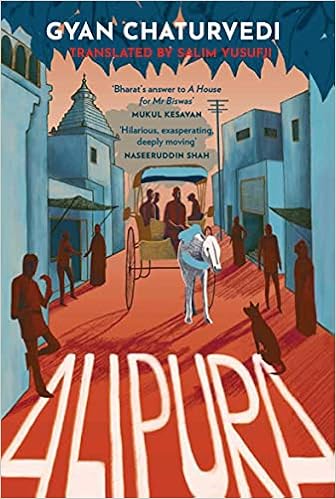
Alipura by Gyaan Chaturvedi

A close look at a family's life in Alipura, in Bundelkhand. Dealing with poverty, academic failure, rowdyism, godmen, the apparently endless oppression of women, love across caste lines, a match making uncle, his four nephews and niece, (the children of his widowed sister, an amazing character in her own right), it is a richly compelling, rollicking read. Written with great humour, (and a vast array of cuss words, decently camouflaged) it holds you completely in thrall. Brilliantly translated from the Hindi by Salim Yusufji.


These books are my most recent reads. Other delightful ones are buried in my memory, and might be resurrected some day.


Tuesday, September 28, 2021

Book Review: What We Know About Her

 I first heard of (and heard)  Krupa Ge at an online event featuring Nisha Susan's delightful book, The Women Who Forgot to Invent Facebook and Other Stories. That was when I learned that she had written a book about the devastating floods that almost drowned Chennai in 2015, Rivers Remember: the Shocking Truth of A Manmade Flood, a book that I promptly ordered and read. Chennai is one of my cities, a city I know a little, and love. A friend's family had been through harrowing times during this disaster, and this book gave a very well written, personal and also deeply analytical, view of this crisis.

A few days ago, while browsing on Amazon, I came across What We Know About Her, by Krupa Ge. The blurb was appealing, and the book was soon on my Kindle. I am so very glad that I bought this brilliant book. 

The narrator, Yamuna, is a young woman trying to make sense of her life, of her family history, of her doctoral studies, of her relationships. She visits Benares to spend time with her grandfather, Kannaiya, one of the most appealing and unusual characters I have ever come across. After the death of his beloved wife Subbu, several years ago, he eschews his erstwhile atheism because "I have to hope that it doesn't end here. How can it be that your grandmother and I are done?......I chose to believe that even though I can no longer see her, I can feel her. I can have conversations with her. The dead and the deities play the same role in the lives of the living. They are who we must turn to with life's questions."  Although he does not comment upon it, he is not happy with Yamuna's live-in relationship, but is perceptive enough to know that she is emotionally disturbed.

The narrator intersperses beautifully two story arcs, one in the early 1940's, where much of the narration is in the form of long and beautifully detailed letters that her grandmother, Subbu, writes to her beloved husband, Kannaiya. There is affection, friendship, and tenderness in their relationship. Yamuna is fascinated by her late grandaunt Lalitha, who was a renowned singer, and whose life and death both seem rather mysterious. Her mother tells her," When we hear stories of a nine-year-old married, or thirteen-year- old made in-charge of a household, we think of them a certain way. Like my grandmother and Lalithamma. I knew both women. It's not all 'oh poor dear' you know? They were more than there marriages. They had this ability to build worlds of their own. Limited-entry, invite-only worlds. Where they did as they pleased..........All the while aware of the fact that it was all brief; an incandescence. That it all had to be quickly dismantled and hidden away from those who sought to bind them.........Even in a deeply skewed world,this was possible then, it is possible now."                          

Some of the old stories are truly horrifying, the ways in which young girls are castigated by their own mothers and aunts. And yet, some of them manage to go beyond this punitive childhood training. It's a truly scathing account of women who become the handmaidens of patriarchy.                                      

The evacuation of Madras, intimately known as Patnam, during the second world war, materially affects the protagonist's family. Lalitha's description of the ghost town the city has become is chilling indeed. Her account of the vibrant world of music and cinema which Kannaiya introduces her to seem very real and are most appealing.

The present day arc is equally compelling. Yamuna's confusions, her grandfather's brilliant, gentle intervention in her life, her conflicted relationship with her mother, her depiction of modern day social life, social strata, the expectations within relationships that have the potential to destroy them, and so much more, all interwoven with past events, form a beautifully detailed tapestry with fascinating characters. The house in Chengalapattu is a character in its own right. The cities of Benares and Chennai come brilliantly alive. There is so much going on, with love, both filial and romantic, and forgiveness, playing a stellar role. It is an accurate portrayal of contemporary life with its own complexities....

This is a book to read and savour again and again.


Saturday, September 25, 2021

Blessed are the Vague: For What they Know Not

The vague and the absent minded sometimes lead a charmed life. (Apart from driving their partners up the wall, several times a day, hunting for phone, glasses, wallet, important papers, car keys, basement keys, etc. etc.). " A lost and found and didn't even know it was lost" story from a couple of months ago: 

We were getting some renovations done in the flat we had bought, in the next building from our rented apartment. The spouse had to give some tiles to the contractor's men, tiles which had been stored in a basement storage a couple of buildings further away from ours. I was busy around the house, when I get a rather cryptic call on the intercom. 

Maydum, aapke ghar se koi phone missing hai?

(Ma'am, is there a phone missing from your house?)

My phone was with me, and presumably the spouse had his with him.

Pintu ko basement mein mila hai

(Pintu found it in the basement)

What an earth was Pintu doing in the basement? He was the contractor who was in charge of installing  my kitchen cupboards.

Woh keh raha aapke ghar ka phone hai.

(He says it belongs to your house).

I was, by then, thoroughly confused and irritated.

Maydum, aap uss number par call kar leejiye, clear ho jaayega.

(Ma'am, please call that number, everything will be clear)

That made sense. I dialled the spouse's mobile number.

Ma'am, mein Pintu driver bol raha hoon, Building X se. Building Y ke basement mein yeh phone mila thha.

Okay, there's more than one person called Pintu in the world! And this Pintu has my husband's precious iPhone! He tells me that he is in the lobby of Building X, with the security guard. I tell him that I'm just coming. I pick up some cash, my mask, and lock the flat behind me.

It turns out that Pintu Driver is a friend's driver, someone I know by sight. Since the spouse very rarely, if ever, walks in our complex, I am still wondering how Pintu knew that the dropped phone belonged to my house, and how did he know which flat I live in? There seems to be a very solid information network 'below stairs', as it were.

He hands me the phone, I hand him a tip. He demurs, but I insist. I apologize for the confusion.

And then I proceed to the new apartment, where the spouse is dealing with several different workmen.  I hand him his phone, telling him of its misadventures and emphasizing how I had to chase across the complex in the heat, thanks to his carelessness. 

He hadn't even missed it! 


Friday, September 24, 2021

What kind of wedding?

 Is marriage even relevant today? Many of us wonder, particularly in the urban upper middle class spaces that many of us here are privileged to occupy. It definitely supports many an industry, providing economic benefits to many: the designers, weavers, tailors, caterers, decorators, hotels, marriage halls, and what have you. So much so that sometimes the business generated by matrimony seems to overshadow the actual event: in essence, two people vowing to spend their lives together. These vows could be exchanged in either a legal, religious, or social ceremony. Ceremonies may have evolved over time, in different communities. Tying the knot, either actually or symbolically, often figures. The controversial part for many today is the giving away of the bride to the groom, which has been intrinsic to many cultures across the globe.

When I got married, many decades ago, I was young and starry-eyed, and didn't really question the basic Vedic rituals of our wedding. We had a very simple ceremony in an Arya Samaj temple, followed by lunch at the same venue. It was attended by as many family members and friends who could make it to Delhi at relatively short notice. No cards were printed. I wore a maroon and orange Kanjeevaram, with no zari, woven from an antique design and sourced by my dear teacher, Dr. Anandalakshmy. (I still wear it). I wore a choker made from my great-great-grandmother's bajuband (armlet), a small gold chain with a pendant and small jhumkas, a gold kada on each wrist, glass bangles, and my mother's heavy old paijeb (anklets). My father giving my hand to the groom didn't seem like a big deal at the time, although feminism had definitely become a part of our lives by then.  

Cut to our niece's wedding last November. The groom's parents were recovering from Covid and were too weak to travel, the bride's parents had other ailments making travel difficult, and the grooms's brother had to get back to his job abroad by a certain date, making it difficult to give sufficient legal notice for a court marriage, which is what the youngsters wanted. The spouse came up with the idea of an Arya Samaj wedding. History repeated itself in the self-same Arya Samaj temple, where we were the most senior family members present. The spouse explained to the priest that the kanyadaan part of the ceremony was not required. The priest was sensible enough not to argue about this! It so happened that the bride has an older sister, and the groom an older brother, so the couple was flanked by their siblings and their spouses for the duration of the ceremony. Of course there was live transmission of the ceremony to both sets of parents too. Masks were donned and all eighteen of us participants in this beautiful wedding went for lunch at an open air venue. A few days later, the couple went to visit both sets of parents in their respective cities...

I have loved Leila Seth's account of her son Shantum's wedding, on the banks of the Ganga.

I love weddings where the couple write and recite their own special vows.

I would love a ceremony wherein both sets of parents take their own child's hand, and put it into the partner's hand, simultaneously, blessing them both with a life together full of respect and love.

As parents of adult children, our role is to support them in any way that we can, and grant them the autonomy to live their lives as they choose. 

A marriage is far more than a wedding. Let the wedding ceremony not get in the way of the marriage.

I remember Michael Creighton's words: All love ends, either with the end of life, or the end of love.

Many youngsters no longer believe in marriage, as they have seen too many marriages break up.

In today's uncertain world, I would want my adult offspring to be reasonably happy, whichever way they choose to live.


Saturday, September 18, 2021

A Stranger's Grief


Life can get complicated, the more you try to simplify it. When we bought our own flat, we indulged ourselves somewhat, with a beautiful black glass cooktop and chimney, pretty new tiles etc.. There was a longish gap between the installation of the kitchen equipment, and our actual move, so I actually couldn't light the stove once we did move, because I thought that the electric chimney and  electric gas ignition had a single switch, while they actually had two! (The spouse came to the rescue!) Then we discovered that a couple of the burners were malfunctioning, so a company representative came and set it right. I also felt that the burners were way too hot even at the lowest setting. I couldn't leave the milk to simmer without it boiling over, and most dry vegetables, especially bhindi, would invariably burn. This fellow, the CR for short, however, said that it couldn't be changed, much to my chagrin.

I bumbled along for almost a month, putting another pan under the pan I was cooking bhindi in, and getting used to the Hot Hob's moodiness. And learning to switch on the sleek black electric chimney,which promises to clean itself. I had all intentions of either buying new heavy bottom cookware, or buying a couple of handle-less tawas to use under my existing pans. Airing this intention on a visit to the younger son proved fruitful: he said that if not the hob company, the gas company technician would definitely be able to modify the burner settings. The gas company representative came , but advised us to call the hob company, as the equipment was new and its warranty status should not be jeopardized by having an outsider meddle with it.. And so yet another complaint was registered, and I was happy to learn that the young man who had originally installed the cooktop would be coming to rectify it. He had seemed competent, and was courteous and pleasant. 

He came in this week, and very quickly changed the settings of the three smaller burners. He was very apologetic about not being able to attend to our earlier problem, but said that he had been going through a difficult time. I asked him if he would like to talk about it, and it was as though a dam had burst. He told me that his six month old niece had died in hospital after a brief illness. This young man, in his early twenties, younger that my youngest child, was devastated by this loss. His sister had had a difficult pregnancy, and he had brought her to the city from her marital village. This young man, her husband, and their friends and colleagues, had all pampered her during her pregnancy, and had shared her joy in her beautiful little baby daughter. (She had delivered via C-section). I remembered the pain of losing my infant grand-niece, at two and a half months, and the gloom that had encompassed us all. I told him about the loss of my nephew to Covid. We had a long conversation. Perhaps he was late for his next assignment. It didn't matter. Two people who didn't know each other at all had connected in a kitchen. There's more grief in the world than we can imagine. Let us be kind to one another...